
No products in the cart.

Major July 1, 2026 Federal Student Loan Repayment Changes
What Financial Advisors Need to Know CSLA Board of Standards | July 2, 2026 Yesterday marked a major dividing line in federal student loan repayment p...

The pandemic and subsequent policy actions significantly disrupted trends in student loan balances, repayment rates, and delinquency classifications. Researchers at the New York Fed estimate that more than nine million student loan borrowers will face substantial credit score drops once delinquencies appear on credit reports in the first half of 2025. This analysis examines how pandemic forbearance affected credit scores and projects the impact of returning to normal delinquency reporting.
For this analysis, researchers used the New York Fed Consumer Credit Panel (CCP), a nationally representative sample of Equifax credit reports. They tracked credit score changes for different categories of borrowers from 2019 through 2024 and estimated the potential stock of delinquencies that will appear on credit reports in early 2025. To understand the potential impact, they analyzed pre-pandemic data (2016-2019) to gauge how new student loan delinquencies typically affect borrowers’ credit scores.
The pandemic forbearance on federal student loans significantly impacted the credit scores of affected borrowers. The researchers found an 11-point increase in median credit scores for all student loan borrowers from the end of 2019 to the end of 2020. However, these increases were particularly dramatic for previously delinquent borrowers.
The 2020 forbearance policy marked all delinquent (but not defaulted) loans as current, triggering a 74-point median score increase (from 501 to 575) between 2019 and 2020 for previously delinquent borrowers. Scores continued to rise as negative remarks aged from credit histories.
Defaulted borrowers saw a more gradual improvement as their negative marks aged, and some voluntarily rehabilitated their loans. Then, in Q4 2022, the Fresh Start program marked all defaulted loans as current, boosting median scores for those with a 2019 default by 44 points (from 564 to 608) between 2022 and 2023.
By the end of 2024, previously delinquent borrowers had scores 103 points higher than at the end of 2019, while previously defaulted borrowers saw 72-point increases. Despite these substantial improvements, the median scores for both groups remained in subprime territory (below 620). Overall, the share of student loan borrowers with subprime credit scores decreased from 36.3 percent in 2019 to 28.3 percent in 2024.
To estimate the scope of delinquent student loans, researchers created a “shadow delinquency rate” by combining data from two sources: the CCP and Federal Student Aid (FSA). They summed the total volume of non-federal loans that were 30+ days past due from the CCP with the total volume of federal loans 30+ days delinquent from FSA. They also manually flagged federal student loans serviced by the defaulted loan servicer as past due, beginning when payments resumed. This combined figure was then divided by the total outstanding student loan balance to compute the share of balances over 30 days past due.
Prior to the pandemic forbearance, this shadow delinquency rate reached 14.8 percent in Q2 2018 and remained near 14 percent throughout 2019. After payments resumed post-forbearance, the volume of past-due federal loans quickly returned to pre-pandemic levels and ultimately reached a new high of 15.6 percent by the end of the on-ramp period, with more than $250 billion in delinquent debt held by 9.7 million borrowers.

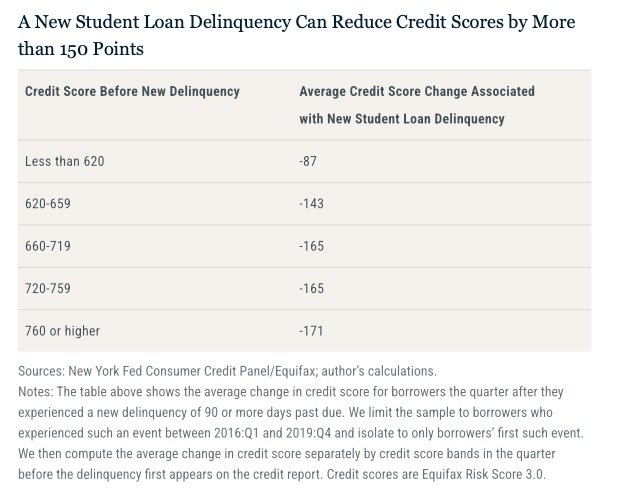
Using pre-pandemic data (2016-2019), researchers estimated the impact that a new 90+ day delinquency has on borrowers’ credit scores, categorized by their pre-delinquency score band:
These findings indicate that borrowers with better credit have more to lose when a new delinquency appears on their credit report. For many borrowers, a drop of this magnitude could move them from prime to subprime status, significantly affecting their ability to access credit.
Several ongoing factors may affect delinquency levels. Borrowers who were past due could have cured their loans by the end of Q1 2025, while others may have since fallen delinquent. Additionally, several court cases are affecting payment statuses. Applications for Income-Driven Repayment (IDR) plans are currently suspended due to federal litigation of the SAVE Plan. This means borrowers cannot enroll in plans that might make monthly payments more affordable, while others already in the SAVE plan are in forbearance and cannot fall delinquent during this period.
The aggregate impact on credit access will depend significantly on the previous credit standing of borrowers with past due loans. If delinquencies are concentrated among borrowers with already low scores, the overall economic impact may be smaller since these borrowers already have limited credit access and will experience smaller score declines. However, if prime and superprime borrowers represent a significant portion of the delinquent population, the aggregate drop in credit standing could be much larger, resulting in reduced credit limits, higher interest rates for new loans, and lower overall credit access throughout the economy.
This research suggests that the resumption of regular credit reporting for federal student loans will have far-reaching consequences for millions of borrowers and potentially broader economic implications as well. The Federal Reserve will continue monitoring student loan delinquency trends as new data become available in the coming months.
Daniel Mangrum and Crystal Wang, “Credit Score Impacts from Past Due Student Loan Payments,” Federal Reserve Bank of New York Liberty Street Economics, March 26, 2025, https://libertystreeteconomics.newyorkfed.org/2025/03/credit-score-impacts-from-past-due-student-loan-payments/.





© 2016-2026 CSLA Institute Board of Standards. All Rights Reserved.
We often send out our newsletter with news and great offers. We will never disclose your data to third parties and you can unsubscribe from the newsletter at any time.
Unfortunately, we’re unable to offer free samples. As a retailer, we buy all magazines from their publishers at the regular trade price. However, you could contact the magazine’s publisher directly to ask if they can send you a free copy.
You can create a new account at the end of the order process or on the following page. You can view all of your orders and subscriptions in your customer account. You can also change your addresses and your password.
No, you don’t have to create an account. But there are a few advantages if you create an account.
You never have to enter your billing and shipping address again
Find all of your orders, subscriptions and addresses in your account
Download invoices of your orders
No, we don’t have a physical store location at the moment. We accept only orders through our online shop and we’re shipping all orders with the Swiss Post Service. Please visit our shipping section for more details.
From time to time you will find us at design fairs and popup markets in Switzerland. Subscribe to our newsletter and you’ll receive the latest news.