

ICR Almost Never Wins on Price. Here's Why People Still Use It.
Student Loans, ICR, Repayment Plans
If you compare your ICR payment to what you'd owe under PAYE or IBR, ICR usually loses. It's often the highest of the three. So why does it still come up in transition planning at all? Because ICR does something the other plans don't: it's the bridge plan for certain Parent PLUS borrowers, and it can produce PSLF-qualifying payments when nothing else will.
Here's how the ICR formula actually works, and when ICR is worth using despite the higher bill.
The ICR Formula Has Two Sides, and You Pay the Lower One
ICR doesn't use a single calculation. It runs two separate formulas and gives you whichever number is lower.
The first side is 20% of your discretionary income. The second side is what a 12-year fixed payment would be, adjusted downward by an income percentage factor that comes from an Education Department table based on your income level. You calculate both sides, then take the lesser amount.
Here's how that plays out on paper. Picture a single borrower with an adjusted gross income of $70,000, a family size of one, and a loan balance large enough that the 12-year side is actually relevant to the comparison. You'd calculate the 20% discretionary-income number first. Then you'd calculate the 12-year fixed payment before adjustment, locate that borrower's income percentage factor on the ED table, and multiply the fixed payment by that factor. Whichever of the two numbers comes out lower is the ICR payment.
That two-step process is exactly why ICR can produce a higher bill than PAYE's straightforward 10% formula or IBR's capped 10% or 15% formula. There's no built-in discount the way PAYE's payment cap works. You're just taking the lesser of two calculations that are both, in most cases, higher than what PAYE or IBR would produce for the same borrower.

Why Anyone Uses ICR If It Usually Costs More
ICR shows up in transition planning for two specific reasons that have nothing to do with getting the lowest bill.
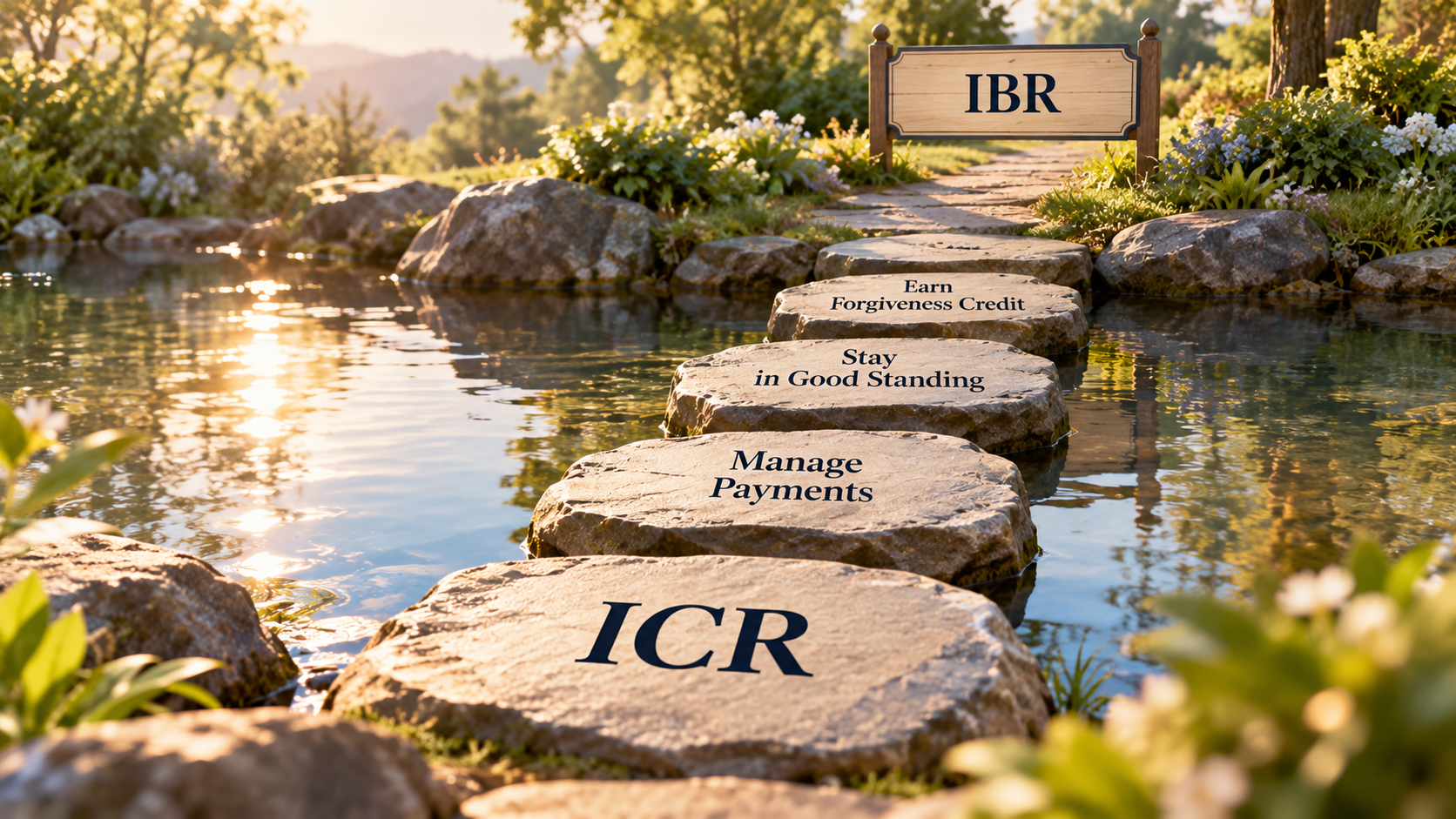
The first is Parent PLUS consolidation. A borrower with a qualifying Direct Consolidation Loan that repaid Parent PLUS debt can use ICR as a bridge plan during the transition, in situations where IBR isn't directly available. Once the required qualifying ICR payment is made within the transition period, the loan may become eligible to move into IBR. ICR isn't the destination here. It's the way in.
The second is PSLF. A parent borrower working for a qualifying employer can use ICR to generate PSLF-qualifying payments during the transition, even while paying more per month than a different plan might charge. If PSLF is the actual goal, the plan that produces qualifying payments matters more than the plan with the smallest bill.
ICR Payments Can Also Count Toward IBR Forgiveness
Here's a detail worth knowing if you're weighing ICR against other options: qualifying payments made under ICR, like qualifying PAYE payments, can be creditable toward the IBR forgiveness timeline under the transition rules. ICR payments don't categorically fail to count toward IBR the way RAP months do. If you end up moving from ICR into IBR later, whether through the Parent PLUS bridge or another path, the time you spent in ICR isn't necessarily wasted from a forgiveness-credit standpoint. Confirm this with your servicer for your specific loans before assuming it applies, since the transition rule's crediting mechanics depend on your loan history.
For Parent PLUS consolidation planning specifically, July 1, 2006 can also matter as a reference date, though only in this narrow ICR context. If your consolidation history predates or postdates that line, it's worth confirming with your servicer whether it affects your ICR eligibility path.

Don't Treat ICR as a Permanent Home
If you're using ICR as a bridge for a Parent PLUS consolidation, you need a plan for what happens after the transition window closes. ICR is a stepping stone in that scenario, not a destination. Confirm the consolidation disbursement date, confirm the qualifying ICR payment has actually been made and processed, and confirm what plan you're eligible to move into afterward before you assume the bridge is permanent.
What to Check Before You Assume ICR Is (or Isn't) Right for You
Run both sides of the ICR formula. Don't assume the 20% discretionary-income side automatically wins. Depending on your balance and income, the 12-year adjusted side might be lower
If you have Parent PLUS consolidation debt, confirm the disbursement date came before July 1, 2026 and that you haven't taken a disqualifying Direct Loan since
If PSLF is your goal, confirm ICR payments are actually being counted as qualifying, not just assumed to count
If you're not pursuing PSLF and don't have a Parent PLUS bridge situation, compare ICR against PAYE and IBR before enrolling. In most cases, one of those will cost you less
ICR is a specialist tool, not a default choice. Know why you're in it before you commit to it, and know what comes after it once the transition window closes.
